



Janitorial Quality Plan
What is a janitorial quality plan? A quality plan is your team’s playbook for meeting expectations and improving service. It’s a written document that defines requirements and the processes that your team will use to
CIMS certification identifies teams dedicated to a high quality of cleaning and operations.
Home > ISSA CIMS Standard
Last Updated
Jump to a section:
CIMS is short for Cleaning Industry Management Standards. This ISSA-run certification is awarded to effective, efficient cleaning teams that pass an auditing process. Certified teams have to meet a long list of criteria across a range of areas, from quality systems to health and safety.
ISSA’s CIMS program certifies that your cleaning organization is running efficiently and effectively. To earn the certification, teams undergo a process that includes documenting their cleaning processes and reviewing their operations with an assessor.
Unlike APPA’s CEFP certification, which applies to a person, CIMS certification applies to the entire organization. Individuals interested in personal certification can explore becoming a CIMS Certification Expert.
ISSA offers a complete document with details on CIMS certification requirements. You can download the full document by filling out a form on the ISSA website.
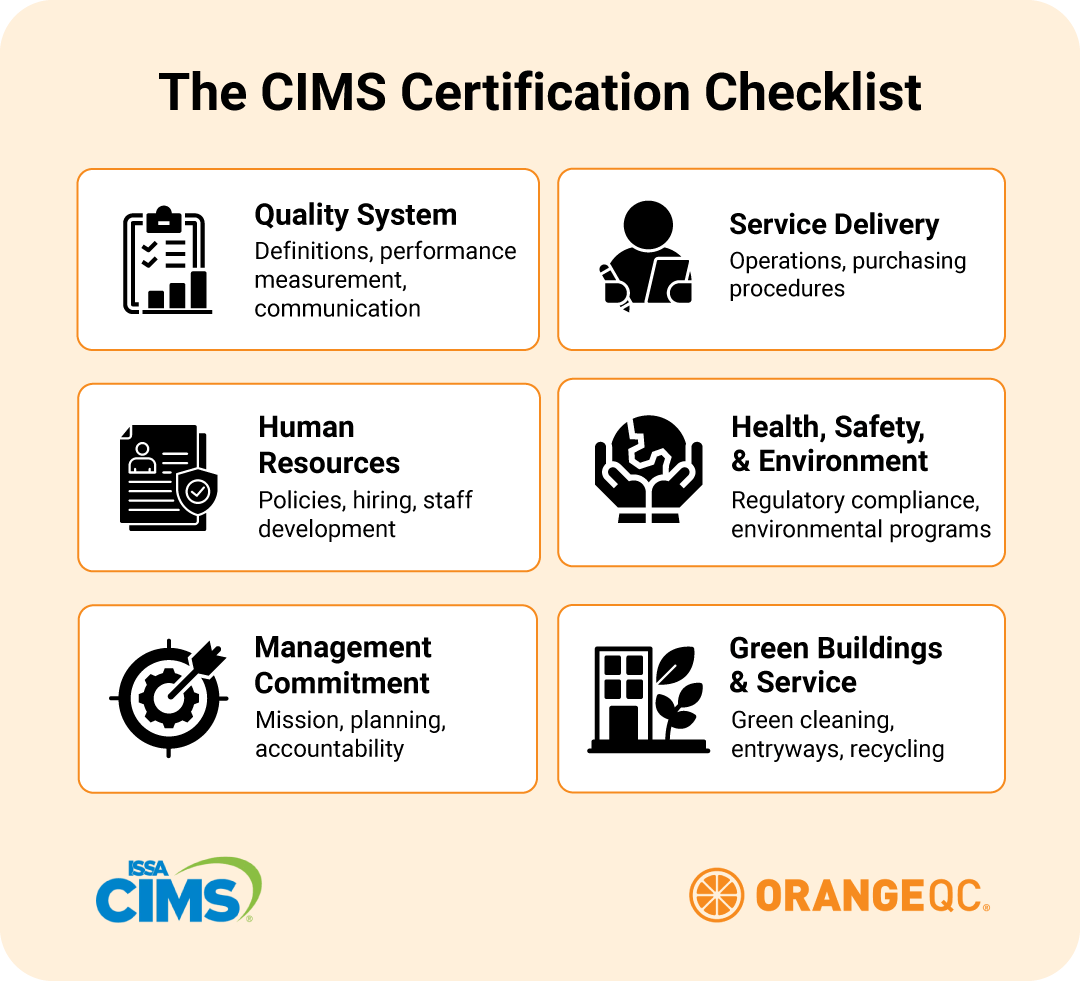
The detailed CIMS certification checklist is broken into six sections. We briefly describe each section and type of topics below, but this is not a comprehensive list.
This includes clear definitions and procedures for how the quality system runs. It’s broken into two parts:
This covers the business operations that help the organization deliver service. It includes:
The human resources assessment focuses on ensuring that people within the organization are well managed. This is a large section with topics including:
This section focuses on ensuring that the team’s work protects people, buildings, and the larger environment. General topics include:
Management commitment focuses on the leadership’s systems. Topics include:
This final section is only graded if the business passes the first five standards. Topics include:
CIMS certification tells your customers that you meet stringent quality requirements. Even if they aren’t sold by the certification itself, well-run businesses tend to attract customers in the long term. CIMS helps make sure you’re checking all the right boxes.
If you’re unsure whether you want to start the certification process, we recommend downloading the CIMS certification checklist and reviewing the standards to see how your team currently compares. Even if you decide not to pursue formal certification, the standards outline best practices and crucial documentation.
For an inside perspective on CIMS, we called up Lance Witschen, a CIMS assessor and president of 1Class Consulting.
He says most of the teams he works with “want to make sure they’ve got all their ducks in a row to actually run their business in the most efficient manner possible, and still provide meaningful service to their clients.”
Witschen says that while price matters to customers, they are also interested in value. “Low price doesn’t always guarantee best service,” he says. “You want to get what you’re paying for.”
Of course, not every client will understand this. However, in the long term, a well-run and effective organization usually wins out.
Witschen says that the biggest tripping point for most teams is having things documented. For example, he might ask what they do for inspections or workloading, and while that particular person might be able to answer the question, they can’t provide a specific place where it’s written down.
“They can’t show you, but they can tell you,” he says. “What’s going to happen when you leave? Who’s going to be able to get into your head and get all this stuff?”
Additionally, the simple act of thinking through the process helps teams identify what’s “slipping through the cracks.” Witschen says this is one of the biggest benefits of the CIMS certification process.
A CIMS consultant can help teams with compiling all those informal processes and disorganized documents into one place, to serve as your organization’s source of truth.
“If they haven’t worked with a consultant prior to me coming in as their assessor, then we have to have a talk,” he says. “I have to tell them, ‘If you want to do this, we’re going to go line by line, and you’re going to document everything.’”
Whether they do it with a consultant or on their own, Witschen says teams who go through that process “feel like they’ve really achieved something” by the end.
“They’ve tightened their business up to the point where they can go out and solicit more business and be confident in what they’re doing,” he says.
Witschen worked with one cleaning team that was underbid by another business. Even though the facility manager was happy with the team, the organization decided to go with the lowest price.
But the story didn’t end there.
The new cleaning team was sloppy. The facility manager started tracking the time she was spending following up with them and getting mistakes fixed. Then, she showed her organization how much the new team was really costing when they factored in her hourly rate.
It turned out to be more expensive (in addition to being a bigger headache with poorer results) to go with the “cheaper” new team.
They hired Witschen’s client back.
CIMS stands for Cleaning Industry Management Standards.
Teams that want to become CIMS certified will be assigned a CIMS Account Executive. This person will work with your team to determine the cost and timeline for certification. After that, you’ll fill out an application. Then, teams work with an assessor, who will schedule an in-person assessment and review submitted documentation.
Both in-house and commercial cleaning companies can benefit from becoming CIMS certified. Going through the certification process helps clarify your team’s processes and standards, while the certification itself can be useful for promotion.
ISSA CIMS certification involves the following fees:
The fees listed above are subject to change, but should provide a general benchmark.
The length of the CIMS certification process depends on the size of your organization and the schedule of your assessor. The initial certification must be completed within six months of the date you submit your application.
ISSA CIMS certification is valid for two years, and can be renewed.

What is a janitorial quality plan? A quality plan is your team’s playbook for meeting expectations and improving service. It’s a written document that defines requirements and the processes that your team will use to

What are environmental safety checks? In the context of facilities, environmental safety checks are visual inspections that look for common hazards that could impact a building’s occupants. Last Updated Jump to a section: Sign up

What is a janitorial PR report? A janitorial PR report captures client feedback on the cleaning team’s service. The goal: Open up communication between the contractor and the company. It also presents an opportunity for

What Bill 190’s washroom requirements mean for custodial teams New legislation introduced in Ontario requires employers to ensure that washroom facilities for employees are clean and sanitary. Additionally, they’ll have to keep and provide records