

What is a janitorial quality plan?

A quality plan is your team’s playbook for meeting expectations and improving service. It’s a written document that defines requirements and the processes that your team will use to meet or exceed them.

A photo depicting a janitorial inspector in the field looking at a report on a tablet.

Quality is essential for cleaning and facilities teams. That’s why best-in-class teams create and follow through on quality plans. Plans create a shared understanding of the work you’re trying to achieve and a method for reaching those goals. Without a plan, everyone on your team is just working without preparation, which leads to inconsistent results at best.

Quality plan definition

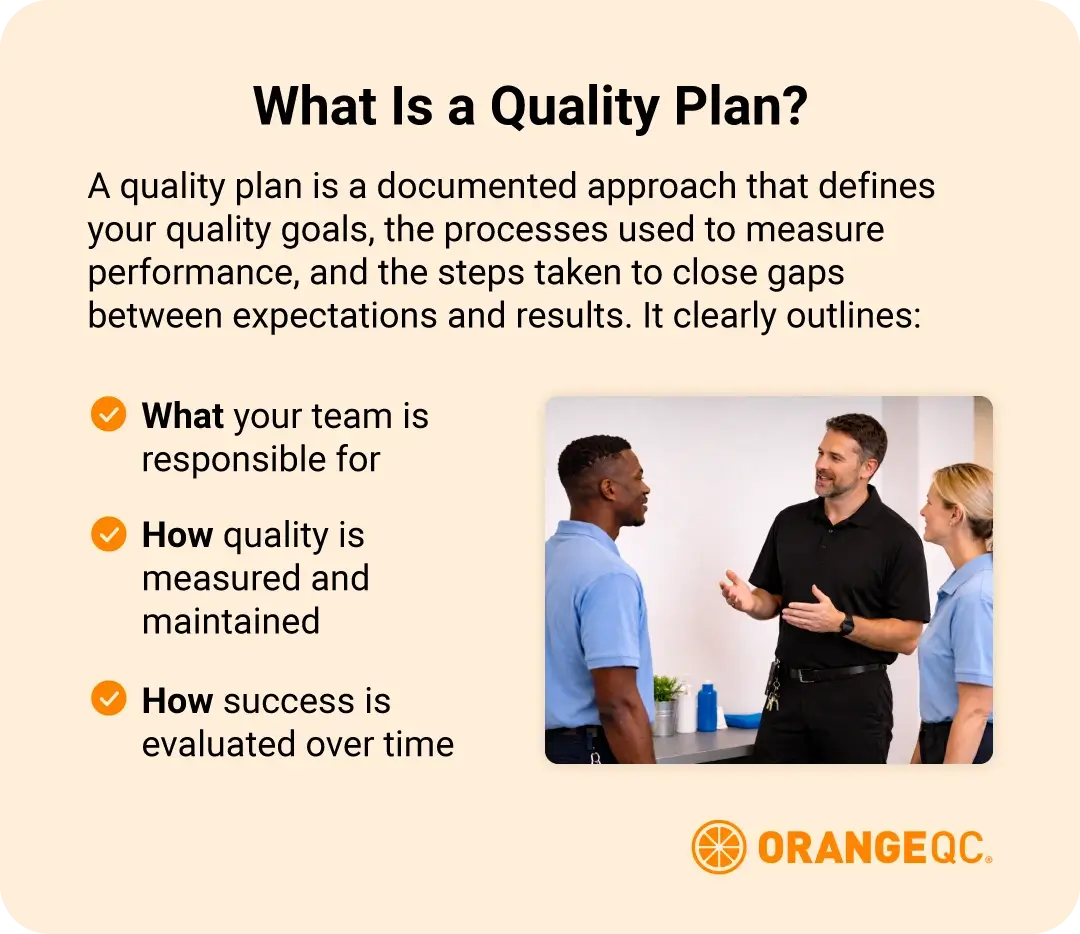
A quality plan is a document that outlines your team’s quality goals and process. It includes steps for measuring quality, comparing quality against goals, and closing gaps between expectation and reality.

The quality plan details what your team is trying to do, how they’re going to do it, and how they’ll know if they’re meeting their goals.

A good plan is highly specific. It should include staffing and equipment requirements, training, schedules, and more.

An illustration featuring a brief definition of a quality plan with a supervisor briefing cleaning staff on a quality plan, referenced above.

Why do you need a quality plan?

Industry best practices, including those from APPA and ISSA, include creating and following a quality plan. That’s because a quality plan helps your whole team work together to improve service.

ISSA CIMS certification, which is for organizations, not individuals, requires a written quality plan. You must communicate the plan to everyone involved, including the customer.

APPA guidance embeds the quality plan within the Deming Cycle (Plan–Do–Check–Act).

Key components of the quality plan

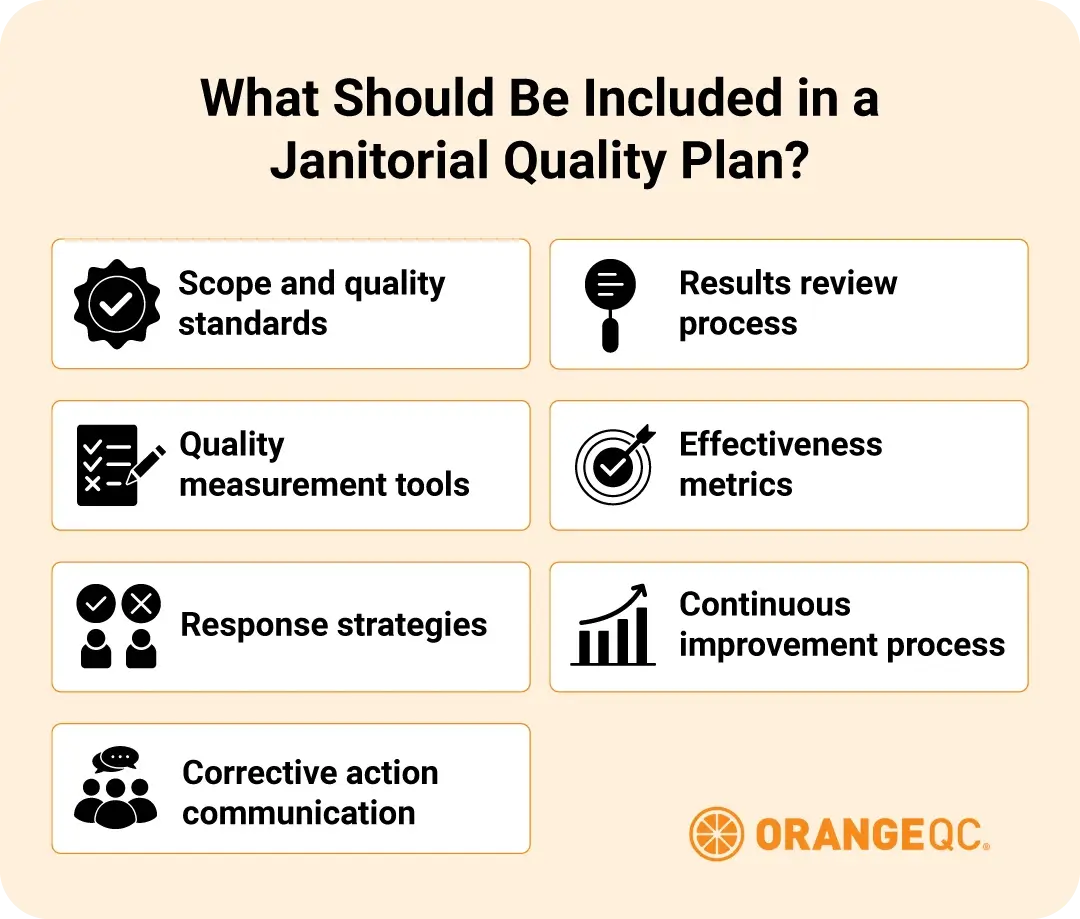
Key components of the quality control plan include:

  • A defined scope of work and performance metrics
  • One or more of the following QA tools:
    • Customer surveys
    • Inspections
    • Complaints
    • Customer evaluations
  • Strategies for responding to positive and negative results
  • Communication around corrective actions
  • A documented process for reviewing results
  • Measurements for the effectiveness of the current process
  • The process for making changes based on gaps between expected and actual results
An illustration depicting what should be included in a janitorial quality plan, referenced above.

Quality planning vs. quality assurance

Quality assurance is part of a quality plan. It compares actual quality levels to quality standards. It’s how teams know whether they’re meeting expectations and where they can improve.

Quality assurance for cleaning teams is most often a visual inspection with line items. Other quality assurance methods may include customer surveys; surface testing, such as ATP measurements; and analysis of complaints, tickets, work orders, and feedback.

How to create a quality plan

When you create your team’s quality plan, you’ll need to gather documents and make decisions about processes that may have always been informal. The quality plan should, for example, include the following parts:
  • Cleaning service requirements for the client, building, or site. These are often part of a contract or SLA, but you may modify them by agreements over time. Write down an up-to-date version of these requirements.
  • Your service process. This should include staffing levels, needed equipment, and training. It details everything your team does to ensure high quality.
  • The measurements your team will use to compare expected and actual performance. This might be APPA’s five levels of cleanliness, a percentage-based score, or another rating system.
  • The process for taking those measurements. This is where quality assurance comes in with tools like inspections. Include the forms your team will use, who is responsible for using them, and any schedules they should follow.
  • A process for reviewing results. Who is responsible for looking at the data coming in? What should they do with that data?
  • A process for improving low scores. What happens when a problem or pattern emerges? What steps can your team take if there’s an issue with training, staffing, equipment, etc.?
  • A communication plan for sharing data with your staff and customers. This should outline what information is shared, how often updates are provided, and which channels you’ll use to keep everyone informed and aligned.

Looking for software to implement your quality plan?

A photo depicting a supervisor walking a facility and talking to a client about a quality plan.

FAQs

Who is responsible for the quality plan?

Team leadership is responsible for creating the quality plan and ensuring that everyone in the organization has the information, knowledge, and tools they need to follow through.

Everyone on the team should have some responsibility for carrying out the plan. Leadership needs to define those responsibilities and communicate why they’re important.

How can my team improve quality planning?

OrangeQC helps organizations run every step of the quality management process, starting with the quality plan. Going digital with a tool like OrangeQC makes the plan and your quality assurance tools available to everyone who needs them.

What is the Deming Cycle (Plan–Do–Check–Act)?

The Deming Cycle is a framework for thinking about improvement. It breaks the process down into four repeatable steps:

  • Plan: Identify standards and gather related documents.

  • Do: Put the plan into action.

  • Check: Measure how well your team followed the plan and if it achieved the desired results.

  • Act: Make changes based on findings from the Check phase, such as adjusting staffing, training, equipment, etc.

More resources

Restroom inspection checklist and guide.

Restroom Inspection Form and Cleaning Checklist

Restroom inspection form & cleaning checklist A good quality control plan involves the entire team. Lay out clear expectations for your custodial staff with a restroom cleaning checklist that helps them pass restroom inspections with

ISSA Cleaning Industry Management Standard (CIMS)

ISSA CIMS Standard

CIMS is short for Cleaning Industry Management Standards. This ISSA-run certification is awarded to effective, efficient cleaning teams that pass an auditing process. Certified teams have to meet a long list of criteria across a

Facility team member using the OrangeQC cleaning standards app on a smartphone.

Understanding Cleaning Standards

Understanding cleaning standards Cleaning standards create a common language for custodial teams and their clients to talk about expectations and performance. Last Updated Jump to a section: Sign up for a free trial Get a

OrageQC APPA custodial standards.

APPA Custodial Service Standards: The 5 Levels of Clean

APPA custodial service standards APPA’s custodial service levels provide a common benchmark for measuring cleanliness. Originally created for use in educational facilities, the levels are increasingly being used outside of education because they are detailed