
ISSA CIMS Standard
CIMS is short for Cleaning Industry Management Standards. This ISSA-run certification is awarded to effective, efficient cleaning teams that pass an auditing process. Certified teams have to meet a long list of criteria across a

New legislation introduced in Ontario requires employers to ensure that washroom facilities for employees are clean and sanitary. Additionally, they’ll have to keep and provide records of washroom cleaning. Keep reading for more on how to comply with the changes.
Home > Bill 190 Washroom Requirements & Impact
Last Updated
Jump to a section:
Custodial teams can help their customers fulfill their Bill 190 washroom obligations by cleaning regularly, keeping records, and making those records readily available. We’re going to explore the easiest ways for teams to offer this service to their clients.
This article does not constitute legal advice. For any compliance issues, refer to the law itself or consult with your legal adviser.
Bill 190 is part of the Working for Workers Five Act, 2024 (Bill 190) in Ontario, Canada. It includes changes to the Occupational Health and Safety Act by adding two main requirements for washroom facilities provided to employees. First, the washrooms must be clean and sanitary. Second, employers must make the cleaning records for those washroom facilities available.
You can find the full text of the bill on the Ontario government website. The portions of the bill that affect washroom cleaning and records are changes to the Occupational Health and Safety Act.
Employers can fulfill their Ontario Bill 190 requirements by keeping workplace washrooms in a clean, sanitary condition and making cleaning logs available.
Bill 190 stipulates that employers ensure washroom facilities for employees are “maintained in a clean and sanitary condition.” The requirement focuses on the outcome (the condition of the washrooms) rather than the methods (cleaning frequency or surface testing). Custodial teams will have to create their own standards and determine how to best meet them.
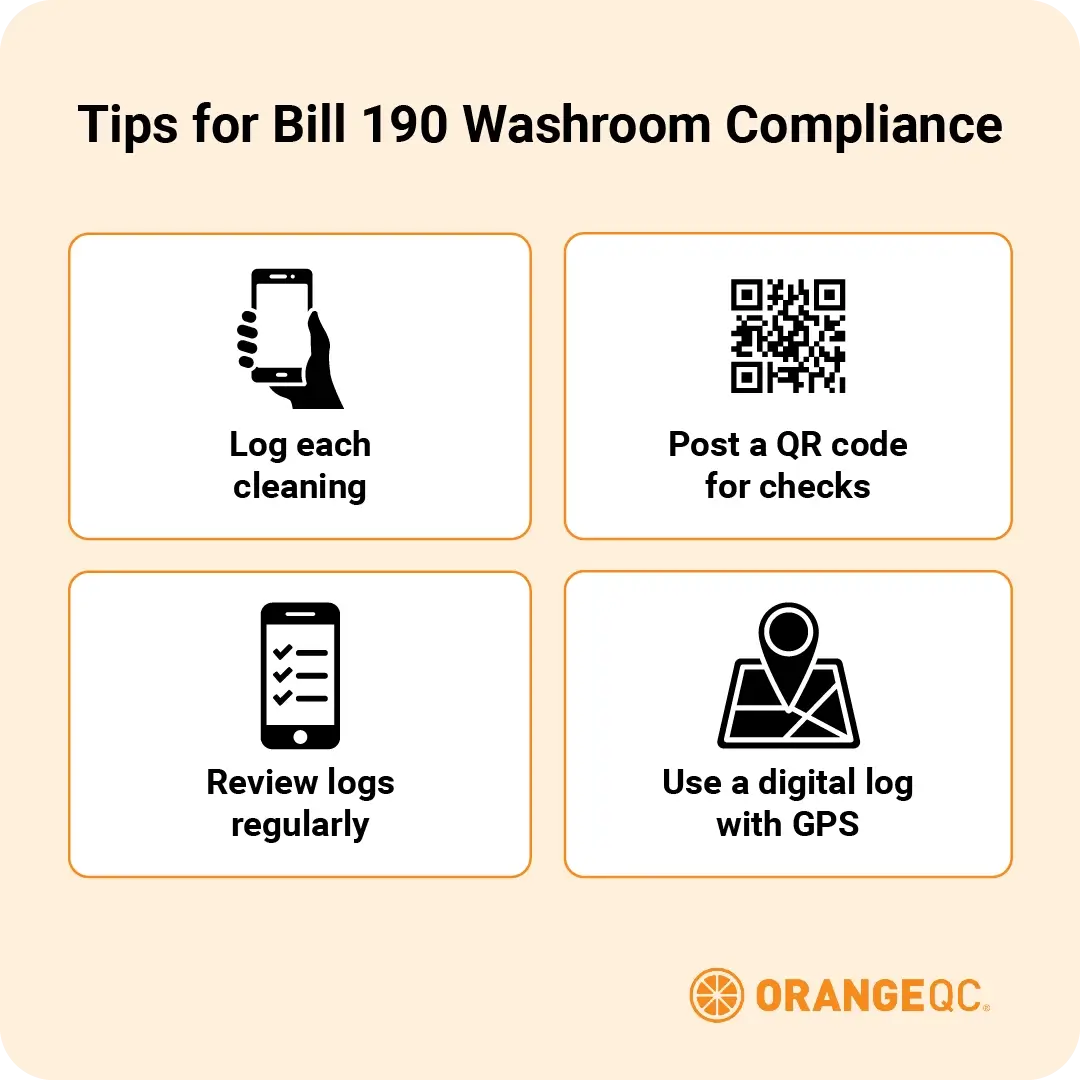
Best practices to meet this requirement:
Ontario Bill 190 also requires that employers make washroom cleaning records available. Ontario Regulation 480/24 clarifies that the record must be either posted conspicuously in or near the washroom, or that it’s posted digitally and workers are made aware of how to access it. The record must also include the date and time of the two most recent washroom cleanings.
Custodial teams can help their clients comply with Bill 190 by keeping a record of completed cleanings and making it accessible to workers.
Best practices to meet this requirement:
In-house and commercial cleaning teams alike may need to help educate their clients on the washroom requirements for Ontario workplaces and explain how they can help with compliance. For commercial teams, this might be included with the current level of service or offered as an add-on.
Custodial teams can help their organizations by:
Paper washroom forms are simple and inexpensive, but they can become another item needing maintenance. They also have to be checked in person.
Digital washroom records can be accessed anywhere. They look more professional, do not get lost, and do not create additional admin work. If workplace washroom service isn’t being completed, supervisors can be alerted right away.
If you’re looking for a digital solution to stay compliant with workplace washroom laws, we recommend checking out OrangeQC. Our cleaning service checklists are perfect for creating a trustworthy cleaning log with timestamps, GPS, and photos. Schedule a call with us for a full walkthrough of our tools.
The Working for Workers Five Act, 2024 is a piece of Ontario legislation that makes additions and amendments to laws affecting workers and the workplace, including workplace washroom laws. The act affects facets of employment, including hiring, job postings, protection from harassment, and more.
According to Ontario’s guide to the Occupational Health and Safety Act, OSHA applies to “most workers, supervisors, employers, and workplaces in Ontario.”
There are some exceptions to OSHA, including for teachers and certain federally run workplaces, which generally fall under different requirements.
Bill 190, Working for Workers Five Act has already begun to go into effect. The portions affecting washroom cleanliness came into force on October 28, 2024 and January 7, 2025. The requirement for making restroom cleaning records available is slated to go into effect on January 1, 2026.
In order for digital cleaning logs to be compliant with OSHA:
Ontario Regulation 480/24 states that the log has to provide the dates and times of the two most recent washroom cleanings.
For construction projects, changes to Ontario Regulation 213/91 require the constructor to keep a log at the site that covers services for six months or the length of the project (whichever is shorter).
Employers should consult with their legal advisers for specific advice on how long to maintain cleaning records for compliance. OrangeQC makes washroom cleaning records indefinitely accessible in a digital format in order to track trends over long periods of time.

CIMS is short for Cleaning Industry Management Standards. This ISSA-run certification is awarded to effective, efficient cleaning teams that pass an auditing process. Certified teams have to meet a long list of criteria across a

Understanding cleaning standards Cleaning standards create a common language for custodial teams and their clients to talk about expectations and performance. Last Updated Jump to a section: Sign up for a free trial Get a

APPA custodial service standards APPA’s custodial service levels provide a common benchmark for measuring cleanliness. Originally created for use in educational facilities, the levels are increasingly being used outside of education because they are detailed