

What is a janitorial PR report?

A janitorial PR report captures client feedback on the cleaning team’s service. The goal: Open up communication between the contractor and the company. It also presents an opportunity for BSCs to clarify the scope of work and propose any changes needed.

A photo of a contractor and a client discussing a janitorial PR report that captures the client’s feedback on the cleaning team’s service, referenced above.

If you’ve ever been blindsided by a client cancellation, you know how hard it can be to gauge customer satisfaction. That’s why public relations inspections are a must. These in-person walkthroughs help catch issues that could otherwise fall through the cracks.

What is a janitorial PR inspection, and why is it important?

The public relations (PR) or joint management inspection brings everyone into the quality control process. A PR inspection allows the team to collaborate with its customers to reach a mutual understanding. Instead of a customer-and-vendor type relationship, you’re now working toward the same goal and collaborating and communicating on the issues.

So how does the PR inspection work, and how can your team benefit from this idea?

How to perform a PR audit

Before performing a PR inspection, you’ll need to ask your customer to meet for a walkthrough together. If you have a usual point of contact or a stakeholder who communicates any issues, those are great people to include. Take a look at the people who are already engaged in the process without you having to loop them in, such as by submitting tickets, requests, or complaints.

Let the customer know you’d like to review cleaning quality and hear about any opportunities for improvement.

During the PR audit:

  • Representatives or key stakeholders from both teams meet in the space.

  • Everyone goes through the inspection form together. If possible, the customer controls the form.

  • The facilities/cleaning team member takes note of what’s most important to the customer and clarifies if certain areas of concern are not covered.

  • The final public relations report includes a summarized “grade” of the space overall.

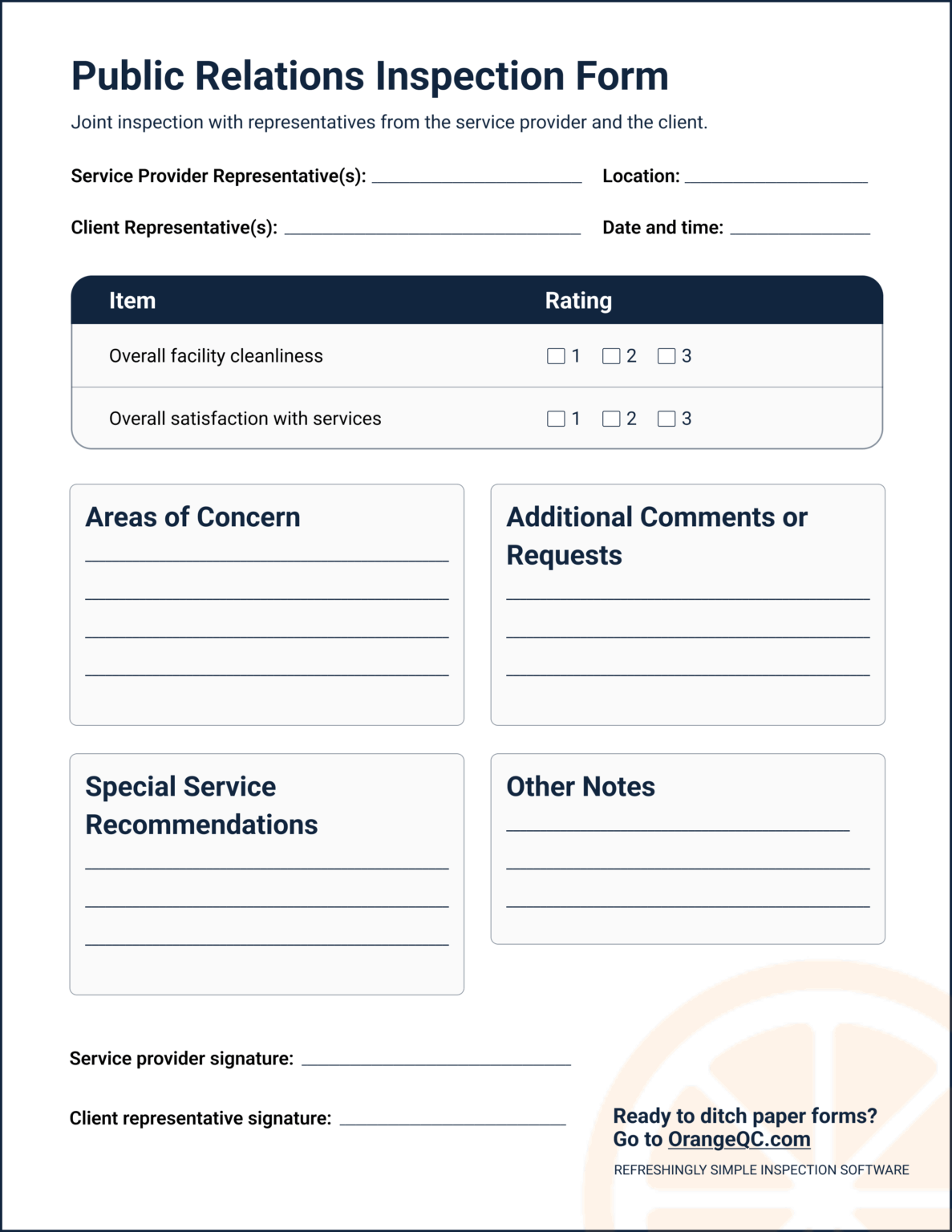
Sample public relations inspection template

A good PR inspection form provides enough structure to guide the conversation to any issues or miscommunications your team needs to know about, while leaving room for it to flow naturally. By keeping any quantitative ratings simple (such as 1–3), you’ll hear more explanation behind the score.

Item Rating
Overall facility cleanliness 1-3
Overall satisfaction with services 1-3
Areas of concern Text field
Additional comments or requests Text field
Special service recommendations Text field
Other notes Text field
Service provider signature Signature
Client representative signature Signature

Next steps after a PR inspection

A post-inspection report captures insights and creates a record of your conversation. As you repeat PR inspections, compare new results and watch for trends.

After each inspection, send a digital PR report summarizing the topics discussed and any client concerns. If there are areas of importance to the client that aren’t covered by the current SLA or contract, communicate that and explain why. If appropriate, clarify what additional budget or staffing might be required to cover that service.

What are the benefits of PR inspections?

Conducting regular public relations inspections is a proactive approach to customer service, rather than reacting to problems and complaints. A good PR inspection process will:

  • Close the gap between expectations and the service provided

  • Clarify if certain tasks are out of scope for your current contract or SLA

  • Give your team a chance to address any problems proactively

  • Present the opportunity to upsell services or address budget/staffing needs

How UMN uses student feedback to boost classroom readiness

The anonymized survey process is an optional step to add to the PR inspection process. This is essentially a random sampling of students or tenants at a facility who happen to be there; you’re just documenting their impressions in a quick inspection. It’s about including the people who use the facilities day in and day out, so you have another data point to work with.

For example, universities will sometimes incorporate student feedback. The University of Minnesota has had great success involving students in their quality control process. Depending on the responses, this can be a great win to bring to your client.

How to improve your PR reporting process

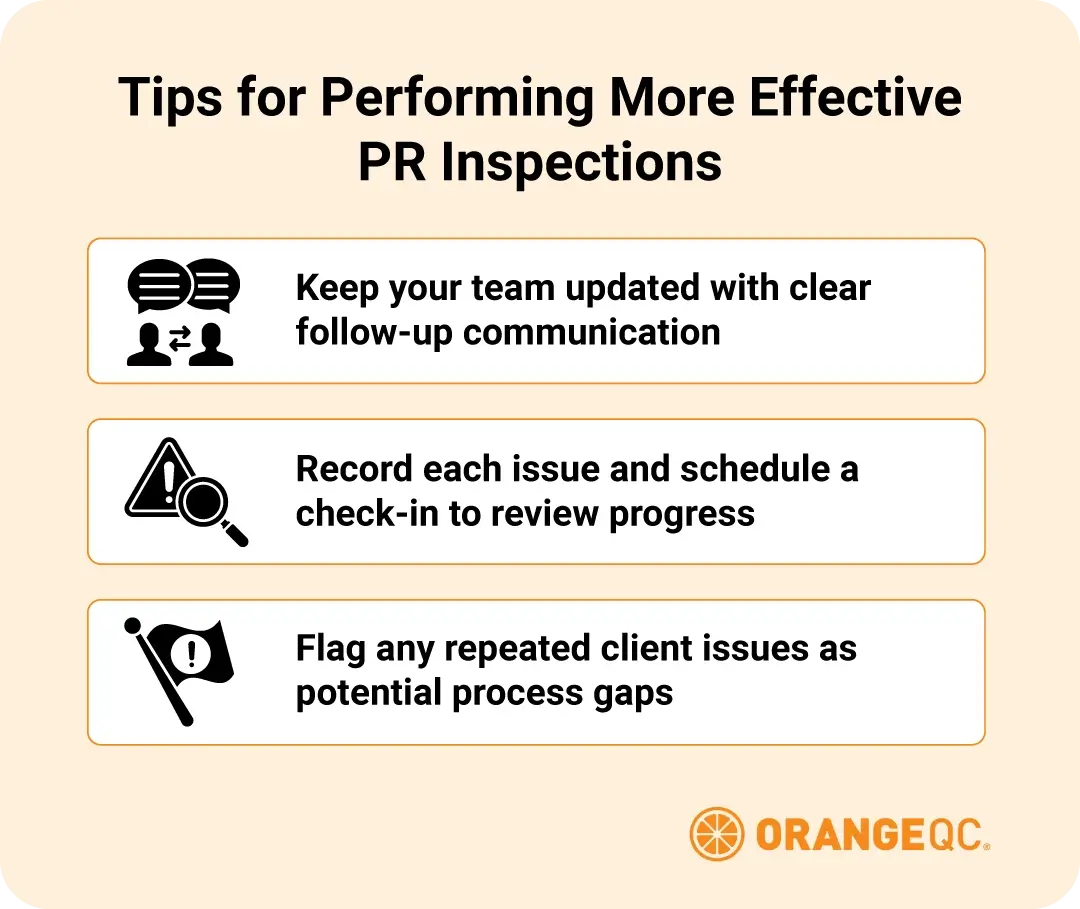
After the joint management inspection, a robust PR reporting process delivers lessons learned to the rest of the team. Follow-through is key. Be sure to:

  • Follow up with communication within the team.

  • Track the issues raised and set a time to review progress.

  • Look for any recurring issues that a client has had to raise more than once, indicating a problem with your process.

Looking for software to improve public relations audits for your clients? We’d be happy to talk about how OrangeQC’s quality tools make it easy to generate professional digital PR reports and get detailed insights from results.

An illustration with tips for performing more effective PR inspections, referenced in the bulleted list above.

FAQs

Who should participate in the PR inspection?

At a minimum, a representative from the customer and one from your team should take part in the public relations inspection. You don’t need to meet with the same person every time; in fact, meeting with different stakeholders can help give you a better picture of the customer’s priorities as a whole, rather than one person’s opinion.

Your team’s representative should be the main point of contact. Bringing in other team members, such as a lead custodian or site supervisor, can also improve communication.

How often should the PR report be completed?

At OrangeQC, we typically see teams doing public relations monthly reports or on a quarterly or semi-annual schedule. If you’re new to PR reports, we recommend starting with a quarterly goal and adjusting it based on your client and team’s needs.

More inspection resources

Office inspection checklist and guide.

Office Inspection Form and Cleaning Checklist

Office inspection form & cleaning checklist Great quality control starts with clear expectations for your cleaning team, then follows through by measuring the results. Whether you modify our office forms or create your own, match

Restroom inspection checklist and guide.

Restroom Inspection Form and Cleaning Checklist

Restroom inspection form & cleaning checklist A good quality control plan involves the entire team. Lay out clear expectations for your custodial staff with a restroom cleaning checklist that helps them pass restroom inspections with
Hallway inspection checklist and guide.

Hallway Inspection Form and Cleaning Checklist

Hallway inspection form & cleaning checklist We’ve put together a sample inspection form and cleaning checklist for hallways and corridors. You’ll also find tips for customizing the form to fit your team’s process, or creating

Facility team member using the OrangeQC cleaning standards app on a smartphone.

Understanding Cleaning Standards

Understanding cleaning standards Cleaning standards create a common language for custodial teams and their clients to talk about expectations and performance. Last Updated Jump to a section: Sign up for a free trial Get a