ISSA CIMS Standard
CIMS is short for Cleaning Industry Management Standards. This ISSA-run

APPA’s custodial service levels provide a common benchmark for measuring cleanliness. Originally created for use in educational facilities, the levels are increasingly being used outside of education because they are detailed and precise.
Home > APPA Custodial Service Standards: The 5 Levels of Clean
Last Updated
Jump to a section:
APPA custodial levels provide a clear, consistent standard for visually evaluating cleanliness. They are often used to create an SLA for a department or contractor and can help predict cleaning times and staffing needs.
APPA cleaning standards are a rating system designed to help teams visually evaluate the cleaning quality at their facilities. Ratings are given in levels from 1 to 5, with Level 1 being the highest and Level 5 being the lowest.
The five APPA custodial service levels provide a clear framework for custodial and facilities teams to use when talking with their organizations about what’s expected, determining staffing levels, and more.
Knowing the level of cleanliness your organization expects allows you to communicate better with them and your team.
APPA’s custodial service levels can be tricky to understand. You may have heard them referred to by many different names, like “levels of cleanliness,” “levels of clean,” “custodial staffing levels,” “custodial staffing standards,” “APPA maintenance matrix,” or “appearance levels.”
In the fourth edition of APPA’s Operational Guidelines for Custodial Facilities, the standards were updated to include an “additional description” for more context about environments in which the standards are appropriate.
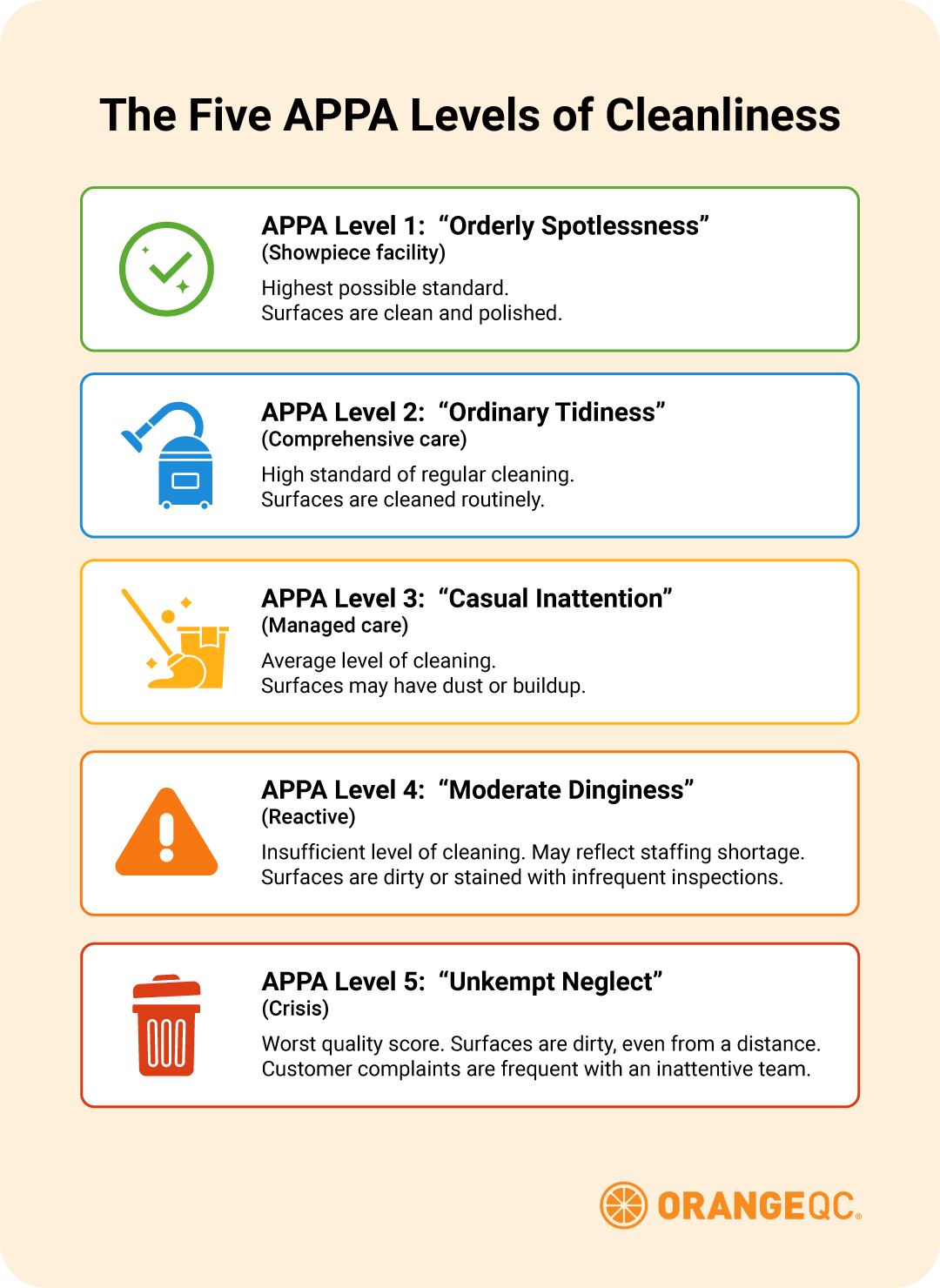
APPA defines the five levels of service as:
For the full descriptions of each level, including what each looks like across all 13 key attributes of a custodial operation, see APPA’s Operational Guidelines for Educational Facilities: Custodial, Fourth Edition, available at the APPA Bookstore. OrangeQC is a contributor to the development of the fourth edition of these guidelines.
To receive the highest APPA scores, teams must use technology that unlocks efficiency and communication. In fact, using technology for digital inspections, surface cleaning measurements, and room set coordination is built into the scoring matrix.
The Fayetteville State University facilities team is dedicated to making the most of its department’s resources. At a 2024 NCAPPA conference, they presented how their team incorporates technology for effective custodial service, all on a budget.
In addition to talking about their work with OrangeQC, the FSU team also shared the technology they use for time tracking, inventory control, and ATP testing.
Though many teams strive for Level 1, some customers choose to only pay for Level 2 or Level 3 in their service level agreement (SLA). Be sure to rate your inspections using the correct scale. If your team needs to hit Level 2, grade on a scale of 2 to 5, instead of 1 to 5. This ensures that you’re not earning “extra credit” in certain areas, which can disguise where you’re not meeting the level needed.
Since you do not get paid more for achieving a higher level than what is specified in your SLA, it’s important to know exactly what level your team is maintaining. That’s where a janitorial inspection software like OrangeQC can come in handy.
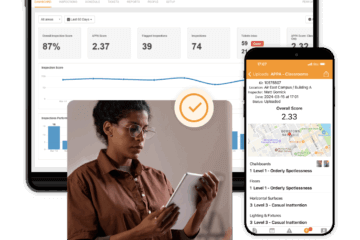
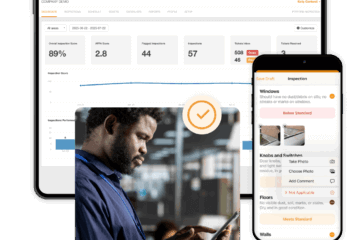
OrangeQC’s app-based inspection forms can be filled out with a few taps on almost any phone or tablet. We give you all the tools you need to capture the right data.
What percentage score does each APPA level correspond with? There’s no “official” answer, but we’ve created our own unofficial tool to convert APPA levels to percentages, which you can customize with your team’s conversion scale.
OrangeQC incorporates APPA’s Operational Guidelines for Educational Facilities: The Industry Standard © 2025 APPA. Permission granted by APPA.
APPA was founded as the Association of Superintendents of Buildings and Grounds. In 1948, it became the Association of Physical Plant Administrators of Universities and Colleges, which is where the acronym comes from.
The name continued to evolve over the years as APPA grew. APPA’s official name is now APPA – Leadership in Educational Facilities. This article offers more insight into APPA membership.
APPA’s Operational Guidelines for Custodial Facilities: Fourth Edition is helpful for teams adopting APPA custodial levels. The book details each standard, describing what each level looks like across all 13 key attributes of a custodial operation. It’s an especially valuable resource for guidelines on costing and scheduling based on space types and desired levels.
A 2008 study titled Cleanliness and Learning in Higher Education found a correlation between the cleanliness of college facilities and students’ academic achievements. It was based on APPA’s five levels of cleanliness.
The study found that custodial work has a real impact on student learning. Findings included:
This study is one of many offering proof that the work of facilities teams is crucial to student learning.

CIMS is short for Cleaning Industry Management Standards. This ISSA-run

Understanding cleaning standards Cleaning standards create a common language for custodial teams and their clients to talk about expectations and performance. Last Updated Jump to a section: Sign up for a free trial Get a